



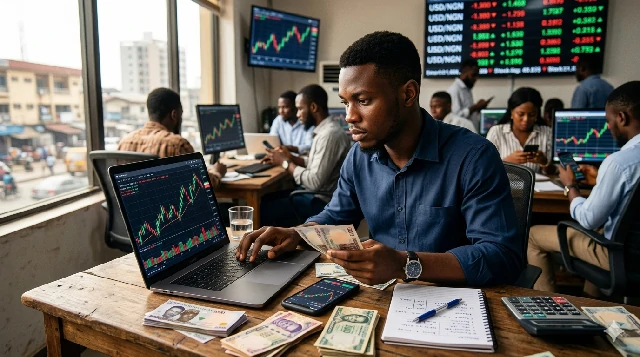
The question of how much money is required to begin trading in Nigeria rarely has a single answer. Ask different traders, and you’ll hear everything from “start with anything” to “you need serious capital.” The truth is more nuanced and depends on your goals and expectations.
According to an article on Guardian Nigeria, it is technically possible to open a trading account with as little as ₦1,500. However, starting with such a small amount often leads to frustration. A more realistic range for beginners is between ₦75,000 and ₦150,000, as it allows for better risk management and a more stable learning experience.
Small trading accounts tend to fail quickly, not necessarily because of poor decisions, but because they lack flexibility. Even one unfavorable market move can significantly reduce or completely wipe out a small balance. With the naira currently trading around ₦1,400–₦1,500 to the dollar, choosing the right starting capital has become even more important.
Can You Start Trading With ₦1,000 or ₦5,000?
Yes, you can start with that amount, but it’s important to understand what that means in practice. At this level, trading is less about making money and more about gaining experience.
With a very small balance, you are essentially learning how trading platforms work, how prices move, and how emotions influence your decisions. These are valuable lessons, but expectations must remain realistic.
One of the biggest mistakes beginners make is expecting small capital to generate significant profits. In reality, small accounts are highly sensitive to market fluctuations. Even minor price movements can eliminate the balance quickly. That’s why such amounts should be viewed as training funds rather than investment capital.
Typical Starting Levels for Traders in Nigeria
Most traders begin within one of three general ranges. The first is the learning stage, usually between ₦1,500 and ₦15,000. At this level, the focus is entirely on gaining experience. Traders learn how to open and close positions, set stop-loss levels, and understand how quickly markets can move.
The second level, often considered the beginner standard, falls between ₦75,000 and ₦150,000. This is where trading starts to feel more structured. You can apply basic risk management principles and survive a series of losses without losing your entire account. This level is critical for building discipline and consistency.
The third level includes traders working with ₦300,000 or more. With higher capital, traders gain more flexibility. They are less pressured to react to every small market movement and can allow their strategies to develop over time. While higher capital does not guarantee profits, it reduces many of the limitations associated with smaller accounts.
Is $100 a Good Starting Point for Forex Trading?
Starting with $100—roughly ₦150,000—is widely seen as a practical option. It provides enough room to manage risk effectively while trading small positions.
This amount allows traders to take losses without panic and evaluate their strategies over time. While it won’t deliver large profits immediately, it creates a more stable environment for learning and gradual improvement.
Choosing the Right Broker
Nigerian traders often choose brokers based on accessibility, features, and ease of use. Platforms like IQ Option are popular among beginners due to their user-friendly interface and demo accounts. HFM offers support for local currency transactions, while XM is known for its educational resources. FXTM also appeals to some traders due to its physical presence in Nigeria.
The choice of broker should depend on your level of experience and the tools you need to trade effectively.
Hidden Costs to Consider Before You Start
Many beginners focus only on their initial deposit, but trading involves additional costs that can affect overall performance.
Reliable internet access is essential, and many traders spend between ₦8,000 and ₦15,000 per month on data. A poor connection can result in missed opportunities or rushed decisions.
Power supply is another factor. Even occasional outages can disrupt trades, so having backup solutions like a power bank or inverter is important.
Banking fees, including transfer charges and other small deductions, can also accumulate over time—especially for traders who frequently deposit and withdraw funds.
Why Small Accounts Struggle to Survive
Trading is not about winning every trade—it’s about staying in the market long enough to improve. With a balance of around ₦100,000, you can risk small amounts per trade and still have enough room to recover from losses.
With ₦5,000, that margin simply doesn’t exist. One or two mistakes can end the trading journey before it even begins. This is not a matter of bad luck but a limitation of insufficient capital.
Final Thoughts
Starting trading in Nigeria does not require a large amount of money, but it does require enough capital to allow for learning and mistakes. A range of ₦75,000 to ₦150,000 offers a balanced starting point for most beginners.
Amounts below that should be treated as practice funds. The key to long-term success lies in patience, discipline, and protecting your capital while developing your skills.