



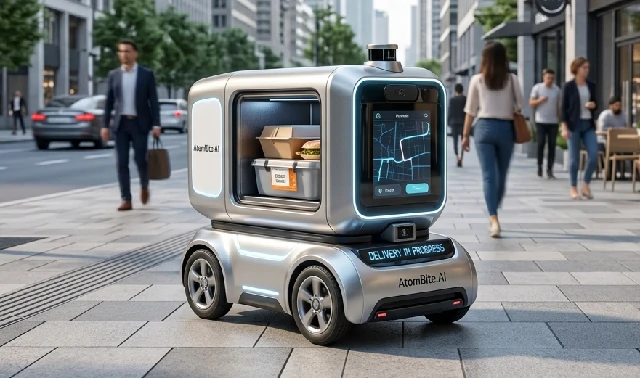
SAN FRANCISCO, CA — AtomBite.AI, an artificial intelligence company focused on robotic manipulation, has officially launched and introduced its first commercial product, the M1 Takeout Packing Robot. The company is targeting inefficiencies in the food delivery ecosystem, particularly the complex and often chaotic final stage of order fulfillment.
As highlighted in an article on AP News, AtomBite.AI is rethinking robotics by prioritizing software intelligence over traditional hardware development. This approach enables the company to enhance existing robotic systems with adaptive capabilities, allowing them to function effectively in unpredictable real-world environments.
A Software-First Approach to Robotics
Unlike many robotics firms that invest heavily in building proprietary machines, AtomBite.AI concentrates on the cognitive layer — the system that allows robots to interpret and respond to their surroundings. Its proprietary dual-model architecture is designed to handle variability in real time, enabling robots to work with irregular objects such as damaged packaging, leaking containers, and mixed-order components.
This shift is particularly significant for commercial kitchens, where consistency is rare. By focusing on adaptability rather than standardization, AtomBite.AI aims to make robotics practical in environments that have traditionally resisted automation.
CEO Dr. Dong Wang has emphasized that the primary challenge in robotics is not mechanical capability but the ability to manage edge cases — unexpected situations that require flexible decision-making. By enhancing robotic “intelligence,” the company seeks to bridge the gap between theoretical AI and real-world application.
Tackling the “Last Meter” Problem
The M1 Takeout Packing Robot is specifically designed to address what AtomBite.AI calls the “last meter” of food delivery — the stage where orders are assembled, checked, and prepared for dispatch. This process is labor-intensive and prone to errors, especially in high-volume kitchens.
The M1 system uses AI-driven recognition and decision-making to accurately sort and pack items, reducing mistakes and improving operational efficiency. Importantly, it integrates with existing hardware, meaning restaurants do not need to replace their current equipment to adopt the technology.
To further simplify adoption, AtomBite.AI offers the robot through a Robot-as-a-Service (RaaS) model. Instead of requiring large upfront investments, the system is available via a monthly subscription, typically ranging from $2,200 to $2,900. This model converts capital expenditure into predictable operating costs, making advanced automation more accessible.
Addressing Labor Costs and Operational Efficiency
The restaurant industry continues to face significant labor challenges, including rising wages and high employee turnover. Replacing hourly staff can be costly, with onboarding expenses averaging thousands of dollars per employee.
By automating packaging tasks, AtomBite.AI’s M1 robot reduces reliance on manual labor while increasing consistency. Its AI-powered visual verification system also helps minimize order errors, which can lead to refunds and customer dissatisfaction.
For restaurants processing around 100 takeout orders daily, the financial impact can be meaningful. The company estimates net monthly benefits ranging from $1,100 to $2,825, driven by both labor savings and improved accuracy.
Built on Logistics and AI Expertise
AtomBite.AI’s founding team brings experience from large-scale logistics and delivery platforms. CEO Dr. Dong Wang is joined by Head of Data Dr. Tao Li and Head of Commercialization Steven Li, who has been recognized on the Forbes China 30 Under 30 list.
The team’s background in managing complex delivery networks and developing algorithmic systems informs the company’s approach. Rather than focusing solely on innovation, AtomBite.AI emphasizes practical deployment — ensuring its solutions integrate seamlessly into existing workflows.
Expanding Beyond Packaging
While the M1 robot is the company’s first product, AtomBite.AI has outlined a broader roadmap. Future developments include systems for kitchen operations (M2) and delivery handoff processes (M3). Ultimately, the company aims to create a “Universal Hand” — a flexible robotic system capable of operating across multiple industries, including logistics and e-commerce.
This phased strategy reflects a long-term vision of scaling embodied AI from specific use cases to more generalized applications.
The Future of Food Robotics
AtomBite.AI’s launch signals a broader shift in how automation is being approached in the food industry. Instead of relying on rigid, hardware-driven systems, the focus is moving toward intelligent, adaptable solutions that can operate in dynamic environments.
By addressing the unpredictability of real-world conditions, AtomBite.AI is positioning itself to play a key role in the next generation of robotics. As adoption grows, such technologies could redefine efficiency and scalability not only in food delivery but across multiple sectors where flexibility is essential.